Virtual CFO Services in Ahmedabad
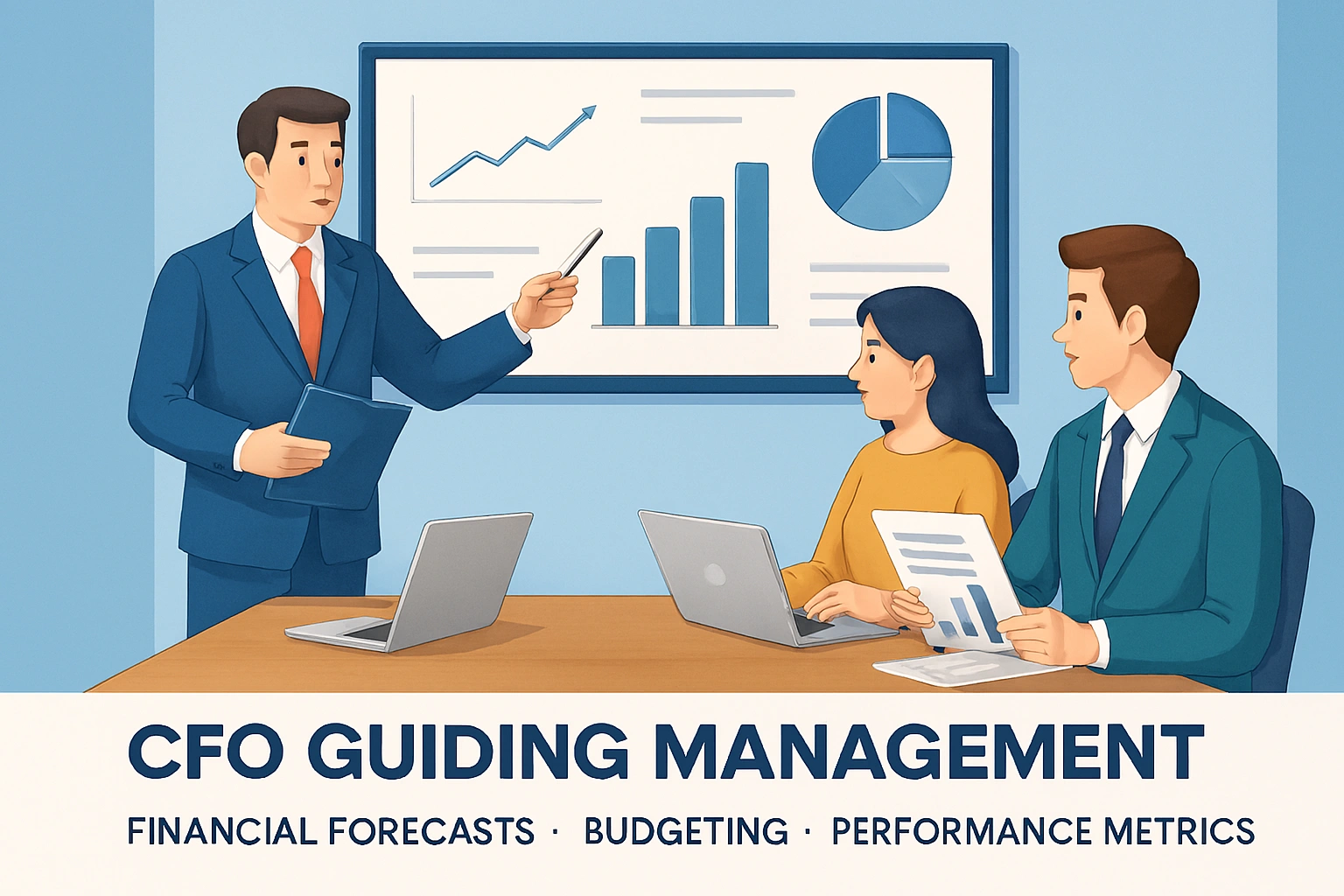


How Our CFO for Growing Collaborative Services in Ahmedabad works?
We start by understanding your business model, CFO financial structure and goals. Based on this, we design a customized CFO engagement covering reporting, planning and advisory support.
Our team works closely with management on a regular basis, provides MIS reports, reviews financial performance and offers strategic guidance. CFO Consulting Services in Ahmedabad get consistent financial leadership without operational overhead.
Key Features of CFO Advisory Services in Ahmedabad
Virtual CFO Services Model
Senior-level financial expertise without full-time cost.
MIS & Financial Reporting
Regular, clear and decision-ready reports.
Cash Flow & Budgeting Management
Strong focus on liquidity and financial discipline.
Strategic CFO Financial Advisory
Support for growth, funding and planning.
Process Of CFO Financial Management Services in Ahmedabad, Gujarat
Business & Financial Review
Understand goals and current financial position.
CFO Scope Finalization
Define CFO services, frequency and reporting structure.
System & Reporting Setup
Implement MIS and financial controls.
Ongoing CFO Support
Regular reviews, analysis and strategic advice.
Detailed CFO Services
Our Core CFO Services
We Provide
Financial Strategy & Performance in Ahmedabad
Financial Strategy & Performance in Ahmedabad focuses on helping businesses plan, manage and improve their financial direction with clarity and control. It includes strategic planning, budgeting, cash flow analysis and process improvement tailored to local business conditions. The goal is to strengthen financial performance, support growth and enable better decision-making.

Strategic Planning
Strategic planning focuses on defining the long-term financial and business direction. It aligns business goals with market conditions and available resources. Financial forecasts and growth strategies are developed to support decision-making. Risks and opportunities are evaluated before major investments. This helps businesses grow in a structured and sustainable manner.
Budget Management
Budget management involves planning, monitoring and controlling business expenses. It ensures resources are allocated efficiently across departments. Regular variance analysis helps identify cost overruns early. Corrective actions are recommended to maintain financial discipline. This improves profitability and financial stability.
Process Improvement
We process improvement reviews existing workflows to identify inefficiencies. Processes are redesigned to reduce delays, errors and unnecessary costs. Financial and operational controls are strengthened. Improved processes enhance productivity and accountability. This leads to smoother operations and better performance in Bodakdev, Ahmedabad.
Cash Flow Analysis
Cash flow analysis tracks inflows and outflows to ensure liquidity. It helps businesses plan for short-term and long-term cash needs. Potential cash shortages are identified in advance. Strategies are developed to optimize working capital. This ensures uninterrupted operations and financial control in Ahmedabad.
Risk Management
Risk management focuses on identifying financial, operational and compliance-related risks. Potential risks are assessed based on their impact and likelihood. Control measures and mitigation strategies are designed to reduce exposure. Regular reviews ensure risks are monitored continuously. This helps protect the business from unexpected losses.
Fund Raising & IPO
Fund raising and IPO advisory support businesses in raising capital and preparing for public listing. Services include financial structuring, valuation support and investor readiness. Regulatory and compliance requirements are addressed at each stage. Management is guided through negotiations and documentation. This ensures a smoother and well-planned capital-raising process.
ESOP's Advisory
ESOP advisory helps businesses design and implement employee stock option plans. It ensures compliance with legal, tax and accounting requirements. Valuation and structuring are handled carefully to align with business goals. ESOPs help attract and retain key talent. This creates long-term alignment between employees and the company.
Financial Reports
Financial reporting focuses on preparing accurate and timely financial statements. Reports are structured to meet statutory and stakeholder requirements. Management receives clear insights into business performance. Transparency and consistency are maintained in reporting. This supports informed decision-making and investor confidence in Ahmedabad.
We also Provide
Governance, Growth & Reporting in Ahmedabad
Governance, Growth & Reporting in Ahmedabad supports businesses in managing risk, ensuring compliance and preparing for expansion. It covers risk management, fundraising and IPO readiness, ESOP advisory and structured financial reporting. These services help businesses maintain transparency, attract investors and scale with confidence in Ahmedabad.

Frequently Asked Questions
Below are few FAQs which we feel you would be having as per our experience regarding this service of CFO Services in Bodakdev, Ahmedabad.
1 How do CFO services help manage a “Growth-Induced Cash Crunch”?
CFO services help forecast cash flows and identify funding gaps that arise when sales grow faster than cash collections. They improve working capital management by optimizing receivables, payables and inventory cycles. Spending is aligned with actual cash availability rather than projected revenue. Short-term funding options are evaluated in advance. This ensures growth does not strain day-to-day operations.
2 What role does a CFO play in debt financing or bank loans?
A CFO prepares financial projections, cash flow statements and documentation required by banks and lenders. They assess the appropriate debt structure and repayment capacity. Negotiations with lenders are supported using accurate financial data. Compliance with loan covenants is monitored post-disbursement. This increases approval chances and reduces financing risk.
3 How is AI changing the role of CFO services?
AI is enabling faster financial analysis, real-time reporting and more accurate forecasting. Routine tasks like data reconciliation and variance analysis are increasingly automated. Right now, CFOs focus more on strategic insights rather than manual reporting. Predictive analytics helps anticipate risks and opportunities earlier. This makes CFO services more proactive and value-driven.
1 How does “Issue-Based Planning” differ from traditional goal-setting in Bodakdev, Ahmedabad?
Traditional goal-setting focuses on fixed targets such as revenue or growth percentages. Issue-based planning starts by identifying critical problems or constraints affecting performance. Strategies are then built specifically to resolve those issues. This approach is more flexible and adapts better to changing conditions. It is especially useful during uncertainty or rapid change.
2 Can AI help in defining and tracking Key Performance Indicators (KPIs)?
Yes. AI can analyze large volumes of business data to identify the most relevant KPIs. It helps track KPIs in real time and highlights deviations early. AI-driven dashboards provide predictive insights rather than just historical data. This enables faster and more informed decision-making.
3 When should we hire a Strategic Advisor vs. doing it in-house?
A strategic advisor is useful when businesses need an external, objective perspective. Advisors are valuable during growth phases, restructuring, fundraising, or major strategic shifts. in-house teams work best for ongoing execution and daily management. Many businesses use advisors for direction and internal teams for implementation. This combination balances expertise and control in Ahmedabad.
1 What is “Zero-Based Budgeting” (ZBB) and why is it trending?
Zero-Based Budgeting means every expense must be justified from scratch for each budgeting period, rather than adjusting last year’s budget. It focuses on cost efficiency, accountability and linking spending directly to business outcomes. in this year, ZBB is trending because businesses are under pressure to control costs amid uncertain markets and tighter margins. It helps eliminate unnecessary or legacy expenses. This makes budgets leaner and more performance-driven.
2 How does AI-augmented budgeting differ from traditional spreadsheet planning?
Traditional budgeting relies on manual inputs and historical data in spreadsheets. AI-augmented budgeting uses real-time data, predictive analytics and scenario modelling. It automatically identifies trends, risks and variances as they happen. Forecasts are more dynamic and continuously updated. This allows faster adjustments and better decision-making.
3 Are thier specific tax incentives for “Green Budgeting”?
Yes, India offers tax incentives linked to environmentally sustainable investments. These include benefits for renewable energy, energy-efficient equipment, electric vehicles and certain ESG-compliant projects. Green budgeting helps businesses align capital allocation with these incentives. It also improves eligibility for subsidies, accelerated depreciation, or concessional financing. This makes sustainability financially attractive, not just environmentally responsible.
1 What does business process improvement actually involve?
Business process improvement involves reviewing existing workflows to identify delays, errors and inefficiencies. Processes are redesigned to simplify steps, reduce manual work and improve control. The focus is on making operations faster, more reliable and cost-effective. Improvements are practical and measurable. This results in smoother day-to-day operations.
2 How does process improvement impact profitability?
Improved processes reduce wastage, rework and operational delays. Costs come down due to better resource utilization. Faster turnaround improves customer satisfaction and revenue realization. Management gains better visibility into operations. This directly improves margins and profitability.
3 Can process improvement be done without disrupting daily operations?
Yes. Process improvement is usually implemented in phases to avoid disruption. Existing operations continue while improvements are tested and rolled out gradually. Employee roles and responsibilities are clarified during the transition. Change management is handled carefully. This ensures continuity while improving efficiency.
1 How does cash flow differ from net profit?
Net profit shows what a business earns after expenses on paper, while cash flow shows the actual movement of money in and out of the business. A company can be profitable but still face cash shortages due to delayed payments or high upfront costs. Cash flow focuses on liquidity and day-to-day survival. Net profit focuses on overall financial performance. Both are important, but cash flow keeps the business running.
2 What are the best ways to improve a negative cash flow position?
Negative cash flow can be improved by speeding up collections, renegotiating payment terms and reducing unnecessary expenses. Better inventory management and tighter credit control help free up cash. Delaying non-essential capital spending can provide short-term relief. Short-term financing options may be used if required. A structured cash flow plan is key to long-term stability.
3 How often should a business perform a cash flow forecast?
Most businesses should prepare a cash flow forecast at least monthly. Growing or cash-sensitive businesses should forecast weekly or fortnightly. Regular forecasting helps identify shortages early and plan corrective action. Forecasts should be updated whenever there are major changes in sales or expenses. This helps management stay proactive rather than reactive.
1 How do you conduct a Qualitative vs. Quantitative Risk Analysis?
Qualitative risk analysis focuses on identifying risks and ranking them based on impact and likelihood using judgment and experience. It uses tools like risk matrices, interviews and workshops. Quantitative risk analysis assigns numerical values to risks using data, financial models and probability analysis. It estimates potential financial loss and scenario outcomes. Businesses often start with qualitative analysis and use quantitative methods for high-impact risks.
2 What roles does “Cyber Resilience” play in modern risk management?
Cyber resilience focuses on a business’s ability to prevent, respond to and recover from cyber incidents. It goes beyond cybersecurity by including data backups, incident response plans and business continuity. As businesses rely more on digital systems, cyber risks directly impact operations and finances. Strong cyber resilience reduces downtime and financial loss. It is now a core part of enterprise risk management.
3 What is “Credit Risk” and how is it managed in Bodakdev, Ahmedabad?
Credit risk is the risk of loss due to customers or borrowers failing to make payments on time. in areas like Bodakdev, Ahmedabad, where businesses deal with high-value clients and commercial transactions, managing credit risk is critical. It is managed through credit assessments, defined payment terms and regular receivables monitoring. Legal safeguards and credit limits are also used. Effective credit risk management protects cash flow and profitability.
1 What is the role of an “Underwriter” in the IPO process?
An underwriter helps a company prepare for its public offering and manages the entire issue process. This includes pricing the shares, marketing the issue and ensuring regulatory compliance. Underwriters assess investor demand and reduce the risk of under-subscription. They also coordinate with regulators, exchanges and institutional investors. Their role is critical to a successful IPO launch.
2 How does a “Direct Listing” differ from a traditional IPO?
in a direct listing, existing shares are listed on the stock exchange without issuing new shares. There are no underwriters setting a fixed issue price or guaranteeing subscriptions. Share price is discovered purely through market demand. Direct listings are generally cheaper but riskier. They are suitable for companies with strong brand recognition and stable finances.
3 When should a company start IPO readiness planning?
IPO readiness should ideally begin 18–24 months before the planned listing. This period is used to strengthen financial reporting, governance and compliance systems. Internal controls and audit processes are upgraded. Management teams are prepared for public scrutiny. Early planning improves valuation and reduces execution risk.
1 How do “Performance-Based ESOPs” differ from “Time-Based” ones?
Time-based ESOPs vest purely based on the employee completing a defined period of service. Performance-based ESOPs vest only when specific targets such as revenue, profitability, or milestones are achieved. Performance-based plans align rewards more closely with business outcomes. They are commonly used for senior leadership roles. Time-based ESOPs are simpler and more widely used for early teams.
2 What is “Tax Deferral” for startups and how does it help?
Tax deferral allows employees to postpone paying tax on ESOP perquisites until a later event such as sale of shares or exit. in India, eligible startups can defer ESOP taxation for up to a prescribed period. This reduces immediate tax burden on employees. It makes ESOPs more attractive as compensation. Startups benefit by improving talent retention.
3 What happens to ESOPs during a “Buyback” or “Secondary Sale”?
During a buyback or secondary sale, employees may get the opportunity to sell vested ESOP shares. The company or incoming investor purchases these shares at an agreed price. Taxes apply based on capital gains rules at the time of sale. Unvested ESOPs usually continue as per the original vesting schedule. Such events provide liquidity to employees without a full exit.
1 What are the four primary financial statements required for external reporting?
The four primary financial statements are the Balance Sheet, Income Statement (Profit and Loss Statement), Cash Flow Statement and Statement of Changes in Equity. Together, they present a company’s financial position, performance, liquidity and ownership changes. These statements are prepared in accordance with applicable accounting standards. They are used by investors, lenders, regulators and other stakeholders. Accuracy and consistency are critical for credibility.
2 What is the difference between IFRS and US GAAP?
IFRS is principles-based, allowing more professional judgment, while US GAAP is rules-based with detailed guidance. IFRS is used in most countries globally, whereas US GAAP is primarily used in the United States. Differences exist in revenue recognition, lease accounting, financial instruments and presentation. in this year, convergence has improved but key structural differences remain. Companies must choose the framework based on regulatory and listing requirements.
3 How does a “Qualified Opinion” in an audit report impact a company?
A qualified opinion means the auditor found issues that are material but not pervasive. It signals limited concerns rather than a complete misstatement of financials. Investors and lenders may seek clarifications or impose additional conditions. It can affect credibility if not addressed promptly. Timely corrective action helps restore confidence.
Have any questions or need clarity on the above? We’re here to help.
Contact usDrive smarter financial decisions with expert CFO services.
Get strategic financial leadership without hiring a full-time CFO. Choose Professional CFO services in Bodakdev, Ahmedabad and take control of your business finances.