Professional Investment Advisory in Ahmedabad
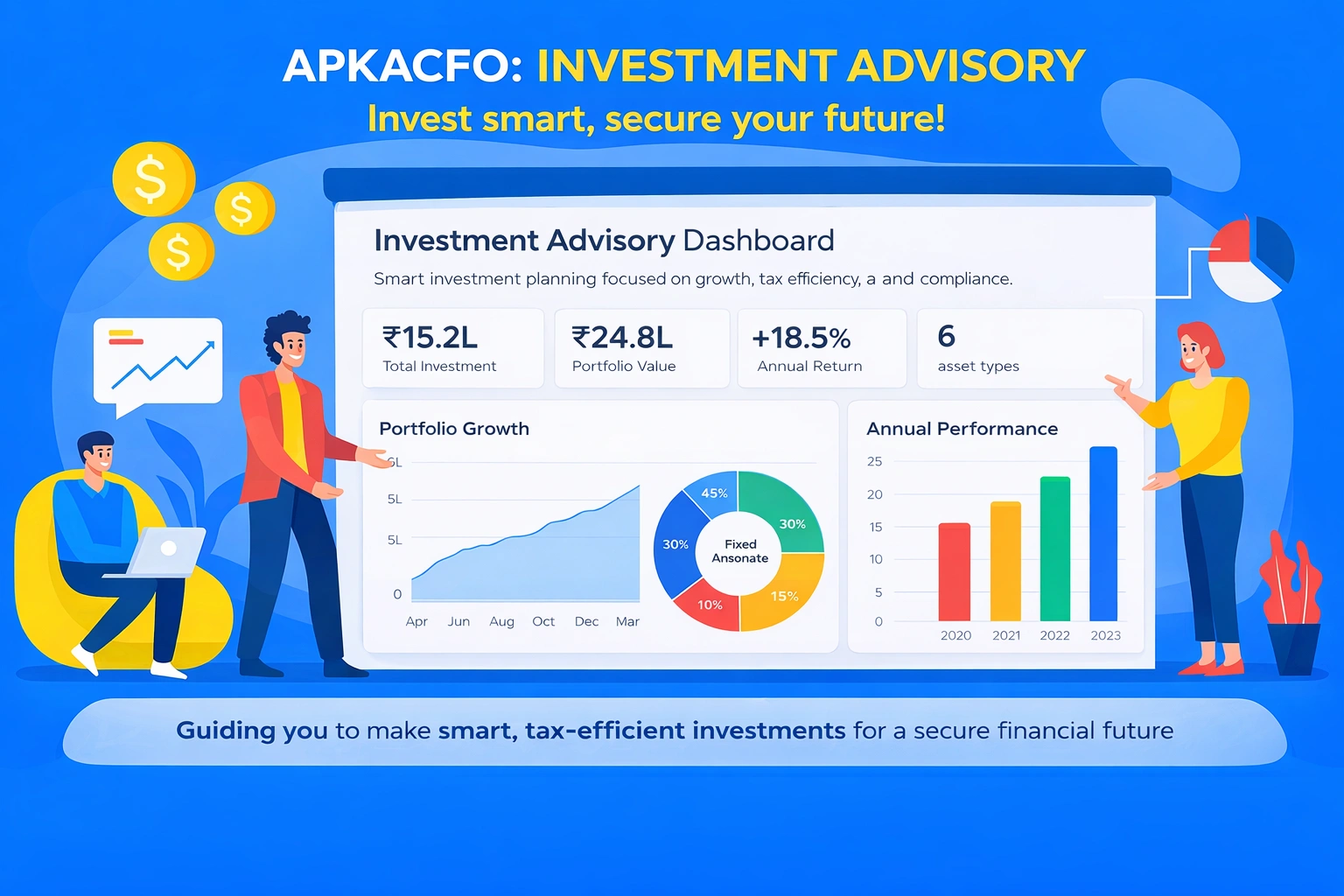

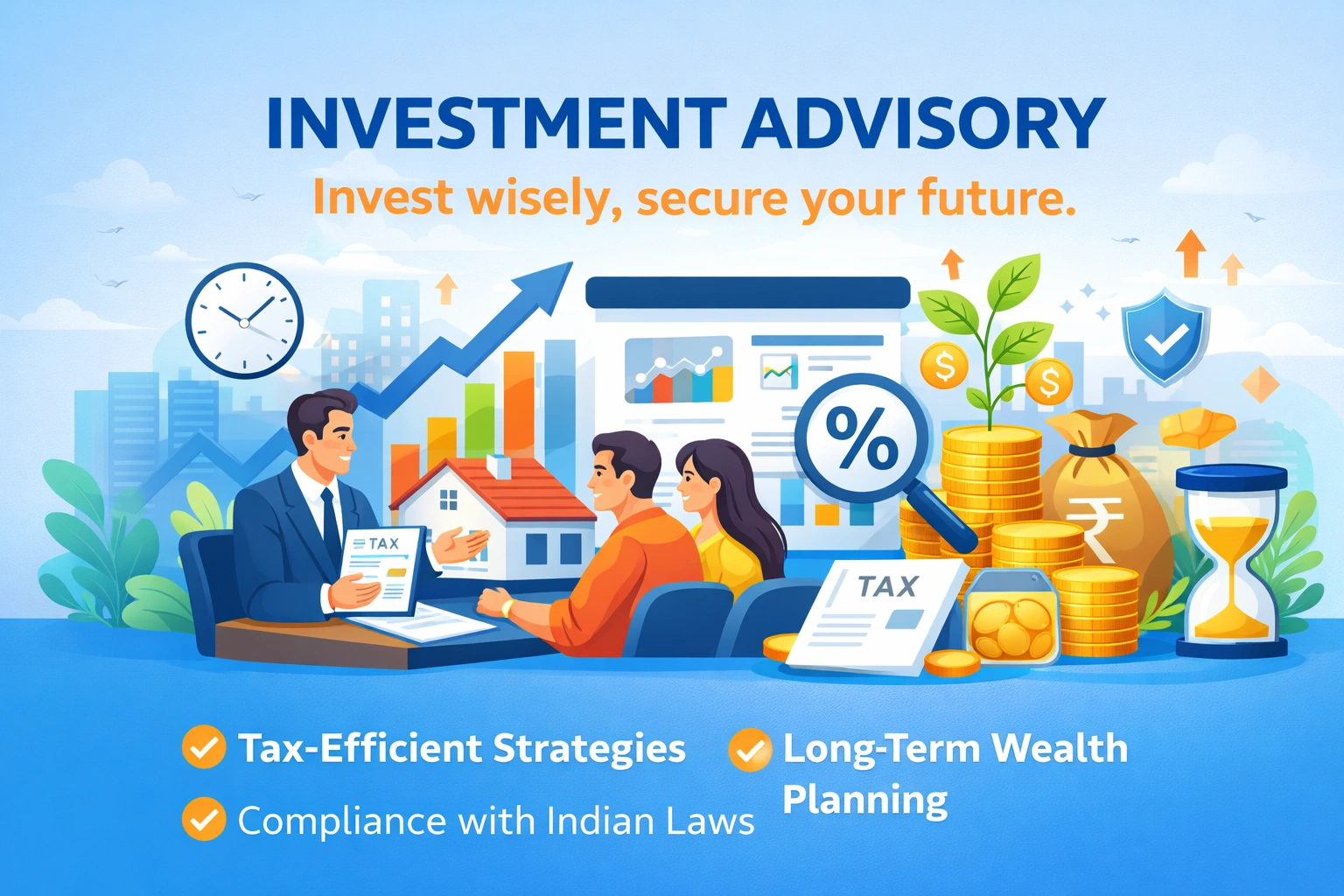
How Our Investment consultant for businesses Services in Ahmedabad works?
We begin by understanding your financial goals, income structure and risk appetite. Based on this, we review your existing investments and identify tax-efficient planning opportunities.
Personal financial advisory services, Our advisory focuses on compliance-friendly investment structuring rather than product selling. We provide clear recommendations and periodic reviews to help you stay aligned with your financial objectives.
Key Features of Corporate Investment Advisory in Bodakdev, Ahmedabad
Tax-Focused Investment Planning
Advisory aligned with Indian tax laws and savings.
Goal-Based Approach
Investment guidance linked to short and long-term goals.
Risk Assessment
Practical evaluation of risk profile before investment decisions.
CA-Led Advisory
Advice backed by financial and tax expertise.
Implementation Process of Long-term Investment Planning in Ahmedabad
Initial Assessment
Understand goals, income and risk profile.
Portfolio Review
Evaluate existing investments and tax impact.
Advisory & Planning
Suggest tax-efficient investment strategies.
Periodic Review
Ongoing guidance to align with changing goals.
Detailed Services
Our Core Financial Services
We Provide
Businesses Investment in Ahmedabad
We provide structured investment advisory services for businesses in Ahmedabad. Our approach focuses on capital allocation, risk assessment and compliance-driven investment planning. We help companies optimize surplus funds while maintaining liquidity and long-term financial stability.

Mutual Funds & SIP
We provide structured Mutual Fund and SIP advisory services in Bodakdev, Ahmedabad. Our approach is based on risk profiling, financial goals and time horizon assessment. We help you select suitable schemes across equity, debt and hybrid categories. Regular portfolio reviews and performance tracking ensure disciplined investing. Our objective is to build long-term wealth through systematic and compliant investment planning.
Business Insurance
We offer comprehensive business insurance advisory services in Bodakdev, Ahmedabad. Our team evaluates operational risks, asset exposure and liability concerns before recommending coverage. We assist in selecting appropriate policies such as fire, marine, liability and keyman insurance. Proper documentation and policy structuring are ensured for smooth claim processing. Our focus is on safeguarding your business continuity and financial stability.
Corporate Fixed Deposit
We provide corporate fixed deposit advisory services in Bodakdev, Ahmedabad. Our guidance includes evaluating issuer credibility, credit ratings and risk-return balance. We help businesses and individuals select deposits aligned with liquidity requirements. Documentation support and compliance review are handled professionally. Our aim is to ensure stable and secure fixed income investments.
Retirement Planning
We offer structured retirement planning services in Bodakdev, Ahmedabad. Our process includes income projection, expense estimation and corpus calculation. We design diversified investment strategies to create sustainable post-retirement income. Tax efficiency and risk management are integrated into the plan. Our goal is to help you achieve financial independence with long-term security.
AIF & PMS
We provide AIF and PMS advisory services in Bodakdev, Ahmedabad for eligible investors. Our team evaluates risk appetite, investment horizon and portfolio objectives before recommending alternatives. We conduct due diligence on fund managers, strategy performance and compliance standards. Transparent reporting and structured documentation are ensured throughout the investment process. Our objective is to enhance portfolio diversification through professionally managed investment strategies.
Personal Finance
We offer comprehensive personal finance advisory services in Bodakdev, Ahmedabad. Our approach covers budgeting, savings planning, debt management and investment structuring. We align financial decisions with your life goals and income profile. Risk assessment and tax planning are integrated into every strategy. Our focus is on building financial discipline and long-term stability.
Wealth Management
We provide holistic wealth management services in Bodakdev, Ahmedabad. Our strategy combines investment planning, risk management and tax optimization. We create diversified portfolios aligned with long-term wealth objectives. Regular monitoring and performance reviews ensure consistent alignment with financial goals. Our aim is to preserve and grow wealth across generations.
Estate Planning
We offer structured estate planning services in Bodakdev, Ahmedabad. Our advisory includes succession planning, will structuring and asset distribution strategies. We help ensure legal clarity and tax efficiency in wealth transfer. Documentation and compliance support are handled with confidentiality and precision. Our objective is to protect family wealth and ensure smooth intergenerational transition.
We also Provide
Strategic Portfolio Management Solutions in Ahmedabad
We provide professional portfolio management services in Ahmedabad tailored to individual and business investors We design diversified portfolios across equity, debt and alternative investments. Regular monitoring and performance reviews ensure alignment with market conditions and client goals. Our objective is to optimize returns while maintaining disciplined risk management.

Frequently Asked Questions
Below are few FAQs which we feel you would be having as per our experience regarding this service of Investment Advisory in Bodakdev, Ahmedabad.
1 How to choose a reliable investment advisory in India?
Check if the advisor is SEBI-registered (RIA) and verify their registration number on the SEBI website. Review qualifications, experience and fee transparency. Avoid anyone promising guaranteed returns. Ensure they conduct proper risk profiling and provide written agreements.
2 Top-rated digital investment advisory apps in India?
Popular platforms include APKACFO, Groww, Kuvera and Scripbox. These apps offer mutual fund investing, goal-based planning and portfolio tracking. Choose based on features, cost structure and ease of use.
3 How to find SEBI-registered investment advisors for HNIs?
Visit the official SEBI website and search the RIA directory. Look for advisors with experience in wealth management, estate planning and alternative investments. Review their fee model and service structure before engagement.
1 How much return can I expect from a ₹5,000 monthly SIP after 10 years?
If you invest ₹5,000 per month for 10 years, your total investment will be ₹6,00,000. Assuming an average annual return of 10 to 12 percent, the maturity value may range between approximately ₹10 to ₹11.5 lakhs. Actual returns depend on market performance and fund selection. Equity funds may offer higher potential returns but come with higher volatility.
2 What is the difference between Direct and Regular mutual funds?
Direct mutual funds are purchased directly from the fund house and have lower expense ratios because no commission is paid to intermediaries. Regular mutual funds are purchased through distributors or advisors and they include commission costs in the expense ratio. Over the long term, Direct plans usually generate slightly higher returns due to lower costs. However, Regular plans may include advisory and support services.
3 Is SIP safe if the stock market crashes?
SIPs are not risk-free, but they reduce risk through disciplined and periodic investing. During market crashes, you buy more units at lower prices, which helps in long-term wealth creation. Short-term value may fall, but long-term investors often benefit from market recovery. SIP works best when you stay invested with a long-term perspective.
1 What is the difference between General Liability and Professional Liability (E&O)?
General Liability Insurance covers third-party bodily injury, property damage and related legal claims arising from business operations. Professional Liability Insurance, also known as Errors and Omissions (E&O), covers financial losses caused by professional mistakes, negligence, or inadequate services. Businesses offering advisory, consulting, or technical services typically require E&O coverage in addition to general liability protection.
2 How does the Sabka Bima Sabki Raksha Act (2025–2026) change legal requirements?
The Sabka Bima Sabki Raksha framework aims to expand insurance accessibility and strengthen regulatory compliance across sectors. Businesses may face enhanced disclosure norms, stricter compliance requirements and broader risk coverage expectations. It is important to review your existing insurance policies to ensure alignment with updated regulatory guidelines and risk management standards.
3 Can I get insurance for a business that operates entirely on social media?
Yes, social media-based and online businesses can obtain insurance coverage. Policies may include professional liability, cyber insurance, product liability and business interruption coverage. Digital-first businesses should assess risks such as data breaches, client disputes and online reputation exposure before selecting suitable insurance plans.
1 What happens if the company goes bankrupt?
If a company issuing a Corporate Fixed Deposit goes bankrupt, repayment depends on the insolvency resolution process under IBC. Depositors are treated as creditors, but repayment is not guaranteed and may be partial or delayed. This is why credit rating and company financial strength are very important before investing.
2 Can I avoid TDS by submitting Form 15G/15H?
Yes, you can submit Form 15G or 15H to avoid TDS if your total taxable income is below the basic exemption limit. Form 15H is for senior citizens, while Form 15G is for individuals below 60 years. However, if your total income exceeds the exemption limit, TDS will apply as per income tax rules.
3 Can I take a loan against my Corporate FD?
Some companies allow loans against Corporate Fixed Deposits, but it depends on their specific terms and conditions. The loan amount is usually a percentage of the deposit value. Interest on the loan is typically higher than the FD interest rate. Always check liquidity terms before investing.
1 How much monthly corpus do I need to retire?
Your retirement corpus depends on monthly expenses, lifestyle, inflation and life expectancy. A common thumb rule is to accumulate 20 to 25 times your annual expenses. For example, if you need ₹1 lakh per month, you may require ₹2.5 to ₹3 crores, adjusted for inflation and medical costs. A detailed retirement calculation provides more accurate planning.
2 Is NPS better than Mutual Funds after the Budget changes?
NPS offers tax benefits and disciplined retirement-focused investing with partial equity exposure limits. Mutual Funds provide greater flexibility, liquidity and potentially higher equity allocation. The better option depends on your tax bracket, risk appetite and retirement goals. Many investors use a combination of both for balanced planning.
3 How do I protect my retirement savings from medical inflation?
Medical inflation in India typically rises faster than general inflation. Adequate health insurance coverage and a dedicated medical emergency fund are essential. Consider super top-up policies and long-term care planning. Diversified investments that outpace inflation also help protect retirement savings.
1 What is the real minimum investment for PMS and AIF?
The minimum investment for Portfolio Management Services (PMS) in India is ₹50 lakhs as per SEBI regulations. For Alternative Investment Funds (AIFs), the minimum investment is typically ₹1 crore per investor. These limits apply to most investors, though accredited investors may have different structures. Always confirm scheme-specific requirements before investing.
2 How is Category III AIF taxation different from PMS?
PMS investments are taxed in the hands of the investor based on capital gains rules applicable to the underlying securities. Category III AIFs are generally taxed at the fund level and income is distributed to investors after tax implications at the scheme structure. Tax treatment can vary depending on whether the AIF is structured as a trust or company. Professional tax planning is recommended due to complexity.
3 Which offers better liquidity if the market crashes?
PMS generally offers better liquidity compared to AIFs, as securities are held in the investor’s demat account and can be exited based on agreement terms. AIFs often have lock-in periods and defined redemption windows. During market volatility, liquidity depends on fund structure and exit clauses. Investors should review liquidity terms carefully before committing funds.
1 How much should I save for an emergency fund?
You should ideally save 3 to 6 months of essential living expenses in an emergency fund. If you have unstable income or dependents, consider 6 to 12 months. Keep the money in a liquid and easily accessible instrument like a savings account or liquid fund. This fund protects you from job loss, medical emergencies, or sudden expenses.
2 Should I pay off debt or start investing first?
If you have high-interest debt such as credit cards or personal loans, clearing it should be the priority. The interest cost often exceeds potential investment returns. For low-interest loans like home loans, you may balance repayment with disciplined investing. The right strategy depends on interest rates, cash flow and financial goals.
3 What is the 50/30/20 rule and does it work?
The 50/30/20 rule suggests allocating 50 percent of income to needs, 30 percent to wants and 20 percent to savings or investments. It is a simple budgeting framework for maintaining financial discipline. While effective for many, the percentages may need adjustment based on income level, city of residence and financial goals. It works best as a starting guideline rather than a fixed formula.
1 When do I actually need a wealth manager vs a regular advisor?
A regular financial advisor typically focuses on investments, mutual funds and basic financial planning. A wealth manager provides comprehensive services including portfolio structuring, tax planning, estate planning, succession strategy and alternative investments. You may need a wealth manager when your assets grow substantially, your income sources diversify, or your financial situation becomes more complex. High net worth individuals and business owners often benefit from integrated wealth management.
2 How is AI changing how my wealth is managed?
AI is improving portfolio analysis, risk assessment and market trend monitoring. It enables faster data processing and personalized investment recommendations. Robo-advisory platforms use algorithms to optimize asset allocation and rebalance portfolios efficiently. However, human oversight remains essential for strategic decisions and complex financial planning.
3 What is the difference between "growth" and "preservation"?
Growth focuses on increasing capital through higher-return investments such as equities and alternative assets. Preservation prioritizes protecting existing wealth through lower-risk instruments like debt funds, bonds, or structured products. Growth strategies involve higher volatility, while preservation strategies emphasize stability and capital protection. A balanced portfolio often includes both, depending on your financial goals and risk tolerance.
1 Do I really need an estate plan if I am not “rich”?
Yes, estate planning is not only for the wealthy. It ensures your assets are distributed as per your wishes and avoids legal disputes among family members. Even basic assets like property, savings and insurance require proper nomination and documentation. Estate planning also helps protect minor children and dependents.
2 What is the difference between a Will and a Trust?
A Will is a legal document that specifies how your assets will be distributed after your death and comes into effect only after probate. A Trust can take effect during your lifetime and allows assets to be managed and distributed as per defined conditions. Trusts may offer better control, privacy and continuity in certain cases. The choice depends on asset size, family structure and succession goals.
3 How do I handle “sequence of returns” risk?
Sequence of returns risk occurs when negative market returns happen early in retirement while withdrawals are ongoing. This can significantly reduce your long-term corpus. To manage this risk, maintain a diversified portfolio with a mix of equity and debt. Keeping 2 to 3 years of expenses in low-risk instruments can help protect your retirement income during market downturns.
Have any questions or need clarity on the above? We’re here to help.
Contact usYour Partner in Smart Professional Investment Advisory Choices in Ahmedabad.
Make smarter financial decisions with Expert Investment advisory—guiding you toward growth, security and long-term success.